It's 6:40 on a Tuesday. You saw fourteen patients, and five daily notes are still open in WebPT. A friend who works in primary care keeps telling you to try Freed, because it "writes the note while you talk."
She's right. Freed is good at that. It's one of the most popular AI scribes in medicine (they say 26,000+ clinicians), it raised a $30M Series A from Sequoia, and the apps are really nice. If you work in internal medicine, it's an easy pick.
The question for a PT is narrower. Does it write your note, and does that note end up in your EMR without you copy-pasting five sections at 6:40 on a Tuesday?
What Freed gets right
Credit where it's due:
- Languages. Freed handles English plus 14 more, Spanish included. Claire is English-only right now. If a big share of your caseload speaks Spanish, take that seriously.
- Coding help. Freed's Premier plan suggests ICD-10 and CPT codes. Claire doesn't, and that's a deliberate choice. Most of the clinics we build for are cash-based or hybrid, where what matters is a note you can sign, not a billing code. If you bill mostly insurance and want coding suggestions inside your scribe, that's a point for Freed.
What about the app?
Freed has native iOS and Android apps. Claire doesn't, on purpose.
Claire was built around your EMR. It records in a side panel right next to the note you already have open, and when the visit's done, it pushes the note straight into that note's fields. A separate phone app would add steps: record on your phone, then open the extension on your computer, then push. That's the opposite of what a scribe should do to your day.
When you do need your phone, like on a home visit or in the gym away from the computer, Claire's web app runs in your phone's browser. Nothing to install.
Where a general scribe trips up on a PT visit
A primary care visit is mostly talking. A PT visit is talking plus doing. Half the clinically important stuff happens while you're moving a knee or counting reps:
"Okay, bend as far as you can… that's about 115. Better than last week. Now push into my hand. Good, that's a solid 4 out of 5."
A general scribe won't miss that. But it may not write it the way a PT would. You might get Knee flexion AROM 115° (prev 105°); quad MMT 4/5 in Objective. Or you might get a sentence in the narrative about the patient "making progress with knee bending." Both are technically true. Only one is a note you'd sign without rewriting.
Then there are templates. Freed doesn't have a PT template, so you'd build your own, section by section, and keep fixing it until it sounds like PT. Claire comes with PT templates for evals and daily notes, built for how you practice: general, ortho, sports or pelvic health. You start from one and adjust it, instead of starting from a blank page.
And then there's the stuff you said that doesn't go in the SOAP note at all: the three exercises you want them doing at home and the "ice after, not before" you said on the way out.
What a visit looks like on Claire
Here's the actual flow, since that's the part most comparison pages skip.
Before the visit. Open the patient's note in your EMR like you always do. The Claire extension sits in a side panel next to it. If there's anything you want emphasized ("note the new numbness, flag for MD"), type it into the highlights box.
During. Hit Start. Treat. Claire uses a medical speech model and separates your voice from the patient's. If the clinic Wi-Fi drops halfway through, the audio is saved locally and uploads once you're back online.
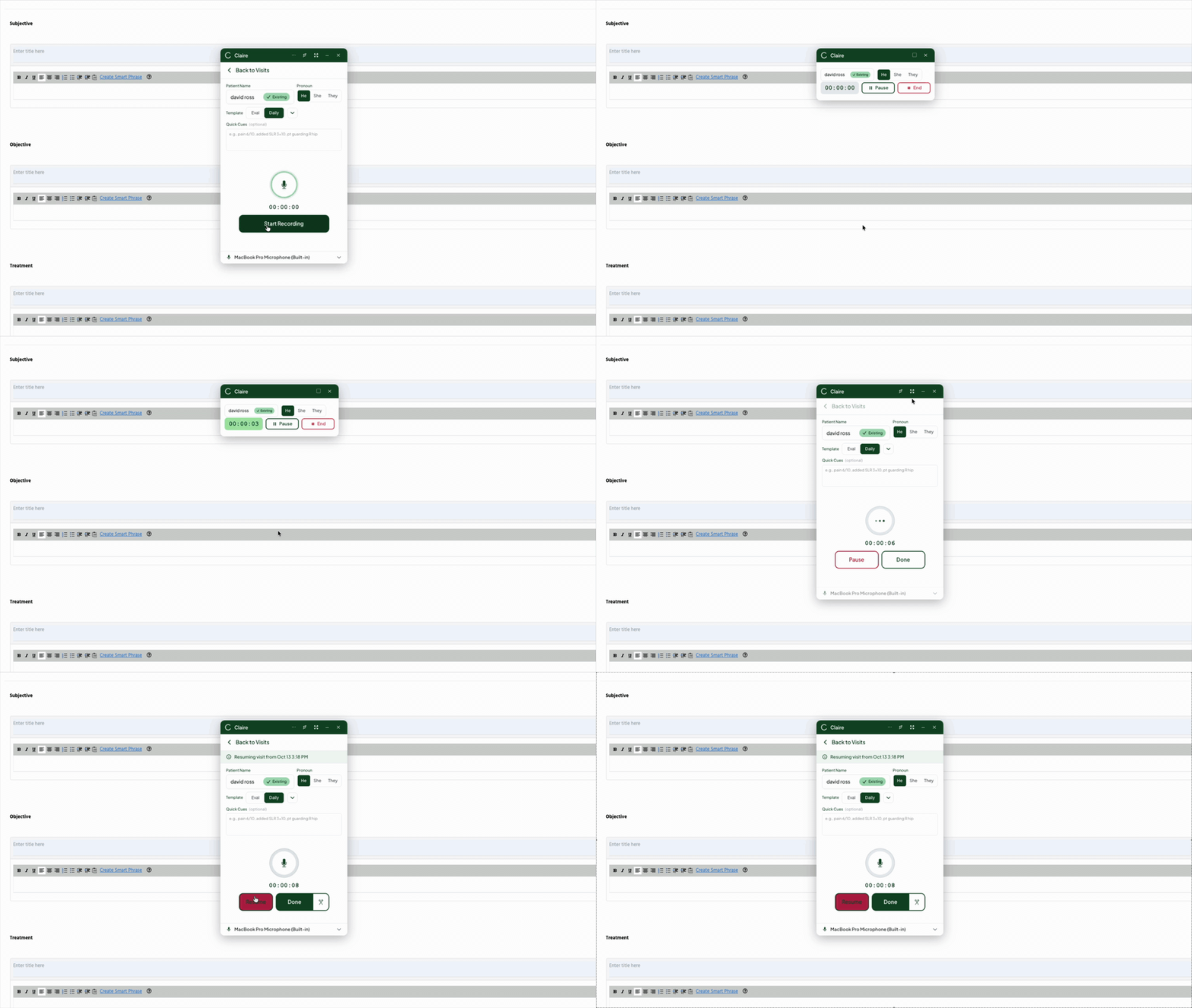
After. Hit Done. A minute or two later you have a daily note in your template. It knows what happened at the eval and the last visit, so goals and the plan carry forward. It also has strict instructions not to invent goals you never set.
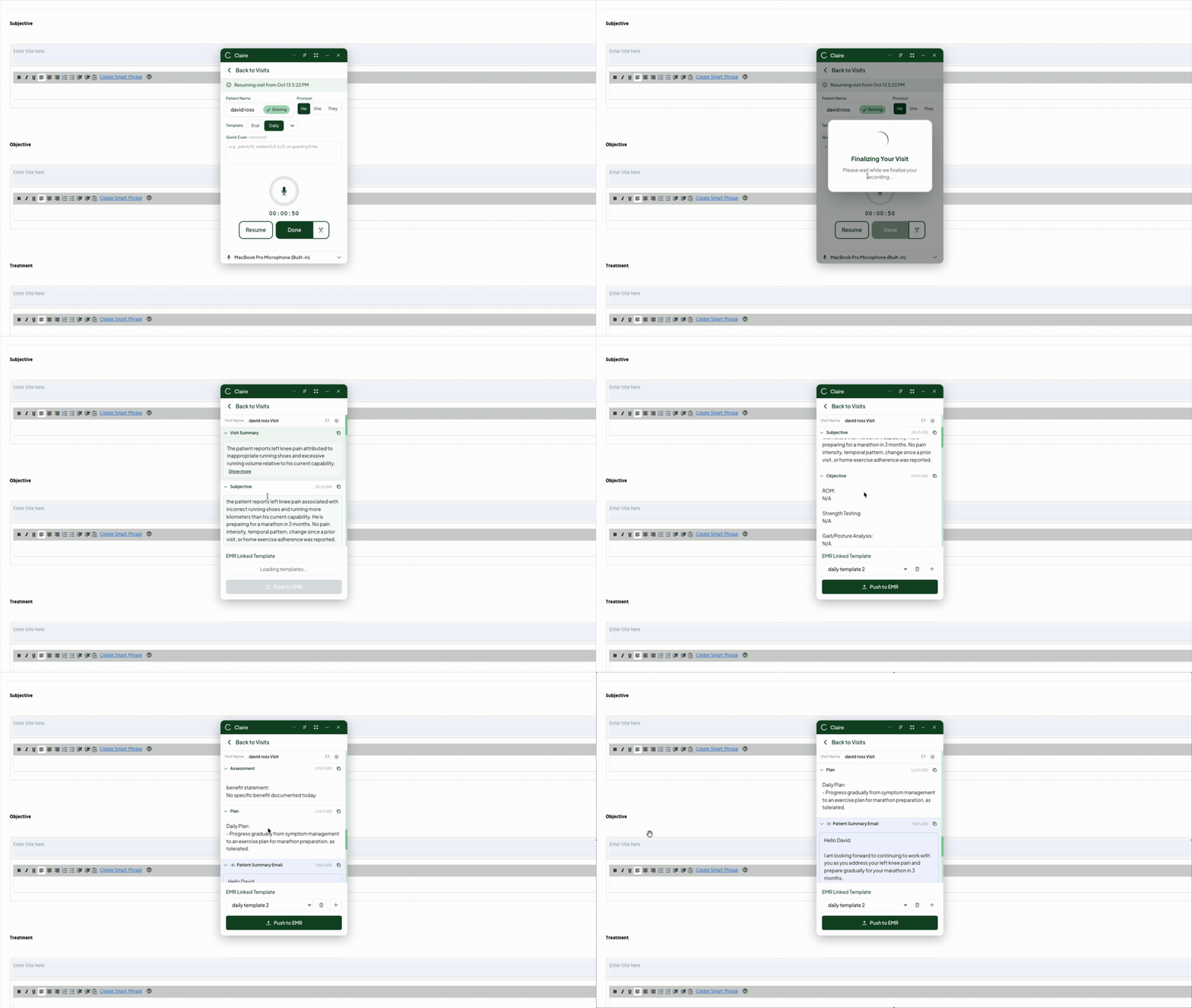
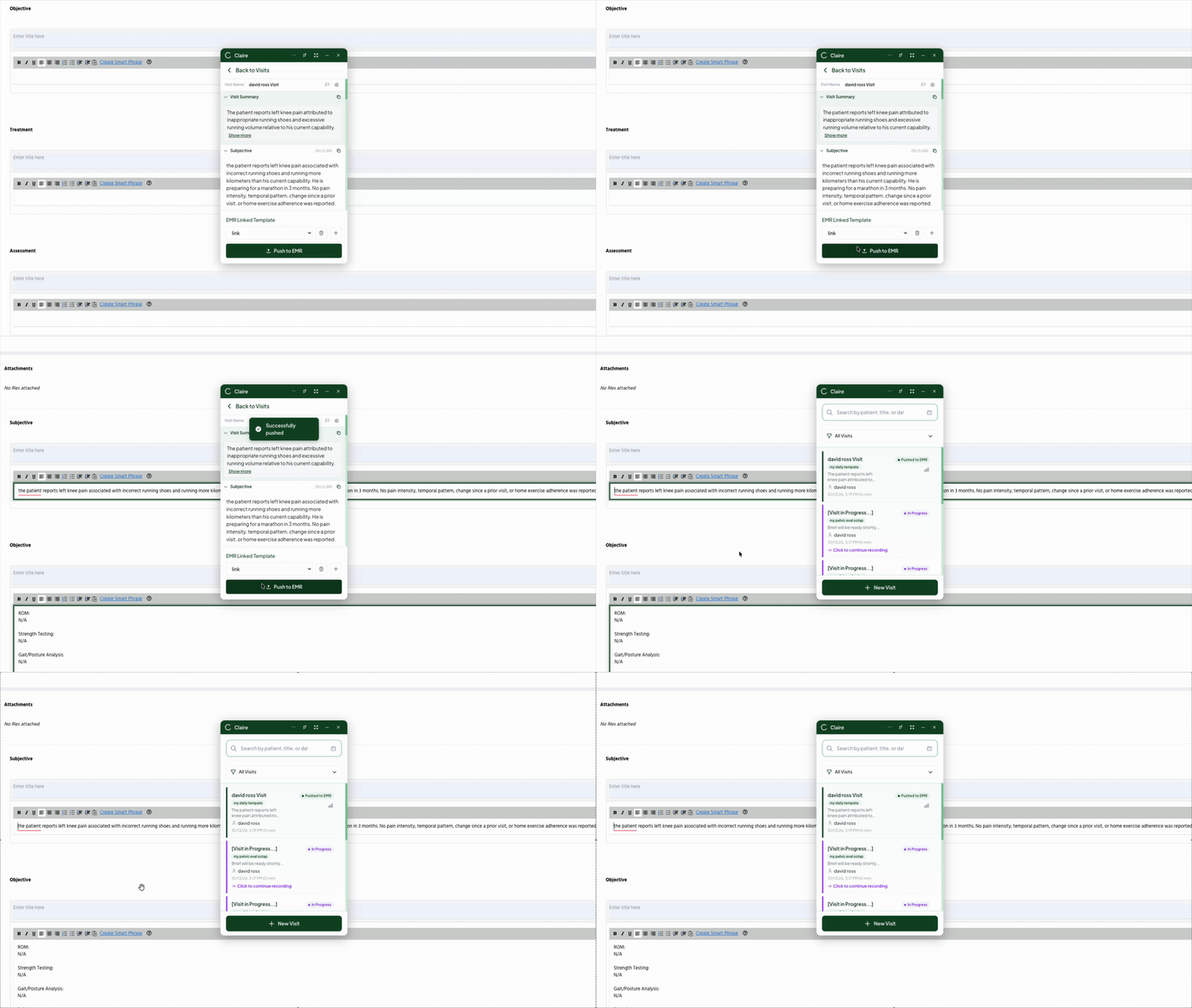
Getting it into the EMR. This is the big one. The first time, you show Claire where each section goes by clicking your EMR's fields in order. It takes a couple of minutes. After that, every note is one click: Claire fills Subjective, Objective, Assessment, and Plan right into the form. You can choose to replace what's there or add to it. This works on WebPT, Prompt, Raintree, Jane, Net Health, HelloNote, PT Everywhere, and dozens of others, and it's included on every plan.
The extras from the same recording. Claire drafts the home exercise program from what you actually did. Sets, reps, frequency, each exercise matched to a video (your clinic's own YouTube channel if you have one). It also writes a plain-English visit summary you can email to the patient. Neither one needs another recording or another login.
Next time. If you change something in a note, like "I always write 'pt' not 'patient'" or "keep the assessment to three sentences," hit Learn. Claire turns your edit into a rule and follows it from then on.
Side by side
| Claire | Freed | Edge | |
|---|---|---|---|
| Who it's built for | Physical therapists only. Templates for general PT, ortho, sports, and pelvic health. | Primary care, internal medicine, mental health, peds, OB-GYN and more. No PT specialty page. | Claire |
| Getting the note into your EMR | Chrome extension fills your EMR's note fields in one click, on every plan. Works across 80+ EMRs, including WebPT, Prompt, Raintree, Jane and Net Health. | Chrome extension 'Push to EHR' for browser-based EHRs, Premier plan only ($119/mo). Named examples are SimplePractice, Tebra, Athena, Elation. Copy-paste below Premier. | Claire |
| PT details in the note | Pulls ROM, MMT grades, special tests, interventions, and patient response into the right sections. Carries goals and the plan forward from the eval. | Strong general SOAP structure. You'd build PT sections yourself in the template builder (Core and up). | Claire |
| Home exercise program | Builds the HEP from what you actually did in the session (sets, reps, frequency), matched to videos, ready to email. | Not a feature. Premier can draft patient instructions. | Claire |
| Learns your style | Edit a note, hit Learn, and Claire turns the edit into a rule it follows next time. You can also write rules yourself. | Learns from edits and supports custom templates. | Even |
| Billing codes | No CPT or ICD-10 suggestions. Claire is built mainly for cash-based and hybrid clinics, where the note comes first. | ICD-10 and CPT coding help on Premier. | Freed |
| Mobile and desktop | Records in a side panel right next to your EMR note, so there's no separate app to switch from. On the go, the web app works in your phone's browser. | Native iOS and Android apps, plus web and desktop. Push to your EHR still happens from the Chrome extension. | Even |
| Languages | English. | English plus 14 others, including Spanish and Mandarin. | Freed |
| Pricing model | From $49/mo for 50 visits ($45/mo billed annually), shared by unlimited therapists. Larger plans up to 400 visits, plus an unlimited-visit plan for solo PTs. | Per clinician. $39 (40 notes), $79 (unlimited), $119 (push, coding, letters). | Claire |
| Free trial | 7 days, full access including EMR push, no card. | 7 days, no card. EHR push isn't part of the trial. | Claire |
| HIPAA | BAA signed in-app during signup. Audio deleted after 14 days. | HIPAA, SOC 2 Type II, org-wide BAA, audio auto-deleted. | Even |
- Who it's built forClaire
- Claire: Physical therapists only. Templates for general PT, ortho, sports, and pelvic health.
- Freed: Primary care, internal medicine, mental health, peds, OB-GYN and more. No PT specialty page.
- Getting the note into your EMRClaire
- Claire: Chrome extension fills your EMR's note fields in one click, on every plan. Works across 80+ EMRs, including WebPT, Prompt, Raintree, Jane and Net Health.
- Freed: Chrome extension 'Push to EHR' for browser-based EHRs, Premier plan only ($119/mo). Named examples are SimplePractice, Tebra, Athena, Elation. Copy-paste below Premier.
- PT details in the noteClaire
- Claire: Pulls ROM, MMT grades, special tests, interventions, and patient response into the right sections. Carries goals and the plan forward from the eval.
- Freed: Strong general SOAP structure. You'd build PT sections yourself in the template builder (Core and up).
- Home exercise programClaire
- Claire: Builds the HEP from what you actually did in the session (sets, reps, frequency), matched to videos, ready to email.
- Freed: Not a feature. Premier can draft patient instructions.
- Learns your styleEven
- Claire: Edit a note, hit Learn, and Claire turns the edit into a rule it follows next time. You can also write rules yourself.
- Freed: Learns from edits and supports custom templates.
- Billing codesFreed
- Claire: No CPT or ICD-10 suggestions. Claire is built mainly for cash-based and hybrid clinics, where the note comes first.
- Freed: ICD-10 and CPT coding help on Premier.
- Mobile and desktopEven
- Claire: Records in a side panel right next to your EMR note, so there's no separate app to switch from. On the go, the web app works in your phone's browser.
- Freed: Native iOS and Android apps, plus web and desktop. Push to your EHR still happens from the Chrome extension.
- LanguagesFreed
- Claire: English.
- Freed: English plus 14 others, including Spanish and Mandarin.
- Pricing modelClaire
- Claire: From $49/mo for 50 visits ($45/mo billed annually), shared by unlimited therapists. Larger plans up to 400 visits, plus an unlimited-visit plan for solo PTs.
- Freed: Per clinician. $39 (40 notes), $79 (unlimited), $119 (push, coding, letters).
- Free trialClaire
- Claire: 7 days, full access including EMR push, no card.
- Freed: 7 days, no card. EHR push isn't part of the trial.
- HIPAAEven
- Claire: BAA signed in-app during signup. Audio deleted after 14 days.
- Freed: HIPAA, SOC 2 Type II, org-wide BAA, audio auto-deleted.
What it actually costs
Freed charges per clinician, and EHR push only comes with its $119 Premier plan.
Claire starts at $49 a month for 50 visits ($45 billed annually), and every plan includes EMR push and unlimited therapists. Clinics move up as volume grows: $119 for 125 visits, $229 for 250, $349 for 400. And if you're a solo PT seeing a full caseload, there's a Solo Provider plan with unlimited visits.
Here's how that shakes out:
| Claire | Freed | |
|---|---|---|
| Solo cash-pay PT, ~45 visits a month, wants EMR push | $49 (Core) | $119 (Premier) |
| 2 PTs + 1 PTA sharing ~240 visits a month | $229 (Clinic) | $357 (3 × Premier) |
| 1 full-time PT, ~260 visits a month, wants EMR push | $99 (Solo Provider, unlimited) | $119 (Premier) |
Both get cheaper on annual billing (Claire from $45/mo, Solo Provider $89/mo; Freed Premier $104/mo). Freed's $79 Core plan is unlimited if you're fine copy-pasting into your EMR.
The pattern: if you want the note to land in your EMR, Claire costs less at every size. A solo PT saves $20 a month or more, and a clinic with PTAs and part-timers saves more because nobody needs their own seat. The one place Freed is cheaper is its $79 Core plan, if you don't mind copy-pasting every note into your EMR yourself.
So which one?
Go with Claire if…
- Your EMR is WebPT, Prompt, Raintree, or another PT system Freed doesn't list.
- You want the HEP and the patient's visit summary to come out of the same recording.
- You've got PTAs, part-timers, or a front desk that should have accounts without paying per seat.
- You want push-to-EMR without paying for a top-tier plan.
Freed is probably the better fit if…
- You treat a lot of patients in Spanish or another language besides English.
- You spend most of the day away from a computer and want a native phone app.
- You bill mostly insurance and want CPT and ICD-10 suggestions inside the scribe.
- You don't need EMR push, and $79 a month for unlimited copy-paste notes is all you want to spend.
Why we'd still bet on Claire for a PT clinic
Freed is bigger than us. More clinicians, more funding, more specialties. That's exactly the difference.
When you build one scribe for primary care, psychiatry, pediatrics and OB-GYN, every decision has to work for all of them. PT is a small slice of that user base, so the things a PT needs (measurements in Objective, goals carried forward from the eval, an HEP that matches the session, push into WebPT or Prompt) compete with everyone else's requests.
Claire has one kind of customer. Every template, every prompt and every feature is decided by what a physical therapy visit needs. When a PT tells us a note got something wrong, that isn't an edge case for us. It's the product. That shows up in three ways:
- More reliable notes. The PT structure is built in, so your Objective section doesn't depend on a template you had to build yourself.
- Customization that fits PT. Section-by-section templates and rules learned from your edits, designed around evals and daily notes, not a generic visit.
- It fits your clinic. Push into the EMRs PTs actually use, on every plan, plus the HEP and patient summary from the same recording.
A big general scribe is a good tool for medicine as a whole. Claire is built for one job: your notes.
Try it on three of your own visits this week (one eval, two dailies) and push them into your EMR. We think you'll sign Claire's notes with fewer edits. And if you run Freed side by side, remember its EHR push isn't in the trial, so you'll be copy-pasting on that side.